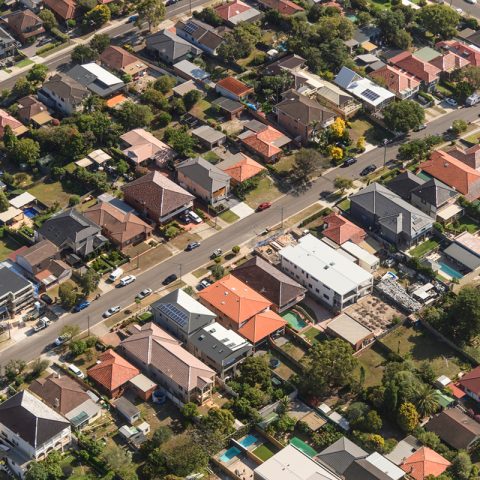
Finding enough homes for a growing population has become one of the biggest challenges facing Australia’s capital cities. While demand continues to rise, many established suburbs remain governed by planning rules that limit the type and scale of new housing. A growing body of research suggests that thoughtful zoning reform could unlock significant housing supply without sacrificing the character that makes many neighbourhoods attractive in the first place.
A recent report from YIMBY Melbourne highlights the extent of the restrictions across the nation’s capitals. According to the report, 76% of residential land located within 20 kilometres of the centre of Australia’s capital cities is subject to planning controls that restrict redevelopment. These controls include two-storey height limits, detached housing requirements, low-density zoning and heritage overlays that reduce opportunities for additional housing.
The report identifies Hobart as the most restricted capital city, followed by Adelaide, Darwin, Perth, Brisbane, Sydney and Canberra. Melbourne ranks as the least restricted, giving it greater flexibility to accommodate additional housing as demand continues to increase.
These findings have reignited debate about whether planning systems designed decades ago are still suitable for today’s housing needs. Population growth, changing household sizes and increasing affordability pressures are forcing governments to reconsider how existing suburbs evolve over time.
One of the report’s authors, Jonathan O’Brien, believes the answer does not necessarily involve widespread high-rise development. Instead, he argues that allowing three-storey townhouses across residential neighbourhoods could dramatically increase housing supply while maintaining a suburban feel.
His modelling estimates that almost nine million additional homes could potentially be accommodated across Australia’s capital cities if this style of development became widely permitted. Such an increase would significantly improve long-term housing availability while making better use of existing infrastructure including roads, schools, public transport and community facilities.
The proposal focuses on what planners often describe as “missing middle housing”. Rather than replacing suburbs with apartment towers, it encourages medium-density housing that blends into existing streetscapes. Three-storey townhouses, duplexes and small residential developments can provide more housing choices without fundamentally changing the look and feel of established communities.
Supporters argue this type of development creates greater diversity in housing. First home buyers, downsizers, young professionals and smaller families gain more options in suburbs that might otherwise only offer large detached homes beyond their budgets.
Infrastructure efficiency is another important consideration. Existing suburbs already have access to transport networks, shopping centres, schools, healthcare and employment opportunities. Increasing housing within these areas allows governments to maximise previous infrastructure investment instead of continually expanding services to new outer suburban developments.
Planning reform, however, remains politically sensitive. Residents often express concerns about increased traffic, parking shortages, pressure on local services and changes to neighbourhood character. Balancing these concerns with the growing need for housing remains one of the most difficult policy challenges facing governments.
Heritage protection is another important part of the discussion. Some opponents worry that greater housing density could threaten historically significant buildings or streetscapes.
O’Brien argues this does not need to happen. He believes planning systems can continue protecting genuinely important heritage buildings while still allowing carefully designed redevelopment nearby.
“You can keep iconic buildings and simultaneously build new buildings next to them or around them or down the street,” he says.
This approach recognises that heritage preservation and increased housing supply do not have to be mutually exclusive. Sensitive planning can retain landmarks that define a suburb’s identity while introducing additional housing in appropriate locations.
The report also suggests that inconsistent planning rules between states create unnecessary complexity for developers, councils and property owners. Different zoning systems, approval pathways and planning terminology often slow development and increase costs.
To address this issue, O’Brien believes the Federal Government should examine the possibility of introducing a national density zoning framework. While local councils would still oversee planning decisions, a consistent national approach could establish baseline expectations across every state and territory.
Greater consistency may help simplify approvals, reduce uncertainty and encourage more investment in housing delivery. Developers operating across multiple states would face fewer regulatory differences, potentially leading to faster project delivery and improved housing supply.
Although zoning reform alone will not solve Australia’s housing shortage, many industry experts see it as one of several essential measures. Other factors including construction costs, labour shortages, financing conditions and infrastructure investment will also influence how quickly additional homes can be delivered.
For buyers, investors and homeowners, these planning discussions have important long-term implications. Areas identified for future medium-density development may experience increased interest as councils gradually update planning schemes. At the same time, suburbs with limited redevelopment potential may continue facing supply constraints that place upward pressure on property prices.
As governments search for practical ways to improve housing affordability, planning reform is likely to remain firmly on the national agenda. The challenge will be finding solutions that increase housing opportunities while protecting the qualities that make Australia’s established suburbs desirable places to live. Thoughtful zoning changes may not provide an overnight answer, but they could become one of the most influential tools available for delivering the homes future generations will need.